
Short answer: An automotive current clamp meter is relevant when the job requires current measurement around one accessible vehicle conductor without opening that conductor for the first check. The Amperemeter listing identifies a compact clamp meter in the UT210E configuration, while UNI-T documents DC current measurement for that model. That establishes the basic product type, but not suitability for every vehicle or circuit. Before buying, confirm the conductor will fit, the expected current is inside the documented range and the instructions cover the intended method. The manufacturer does not specify vehicle-specific approval, calibration status or a complete safety specification on the retailer page.
Start with the current type and conductor
Vehicle battery and accessory circuits use direct current, so a buyer should verify DC current capability rather than assume every clamp meter will do the job. UNI-T's model table includes DC current measurement for the UT210E, and the retailer page locks the product to that configuration.
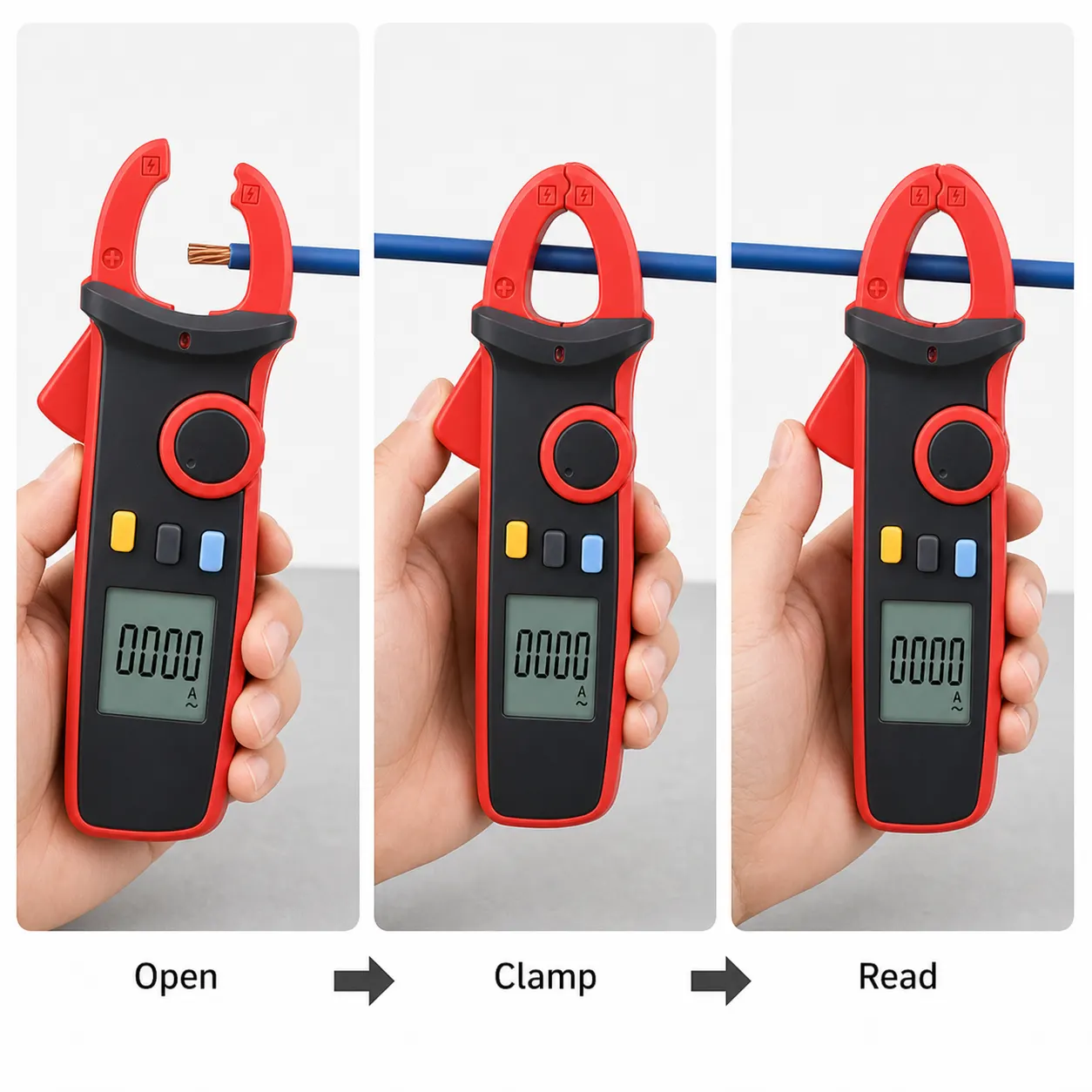
A clamp measures around a conductor. The UNI-T instructions call for one wire to be placed near the centre of the closed jaws. Clamping around a complete paired path can produce a misleading result because opposing currents may not be presented to the sensor as intended.
| Buying check | Evidence available | Boundary |
|---|---|---|
| Current type | UT210E manufacturer material includes DC current | Do not substitute an AC-only clamp |
| Conductor access | Manual calls for one wire centred in closed jaws | Confirm the actual cable can be reached and enclosed |
| Vehicle fit | Retailer positions the meter for vehicle maintenance | Manufacturer does not specify vehicle-specific approval |
| Technical selection | Official model documentation exists | Check the exact manual for range, accuracy and safety limits |
Use the UT210E instructions as the selection test
The manufacturer procedure gives a practical way to screen the purchase. If the intended job cannot be performed with the meter in the correct DC mode, zeroed as directed, around one conductor and with the jaws fully closed, this product type is a poor match before any reading is taken.
- Identify the exact conductor and the current type before selecting the meter.
- Check the UT210E manual for the expected current and operating conditions.
- Confirm there is room to position the clamp without contacting exposed or moving parts.
- Plan to zero the DC current display and close the jaws fully around one conductor.
- Choose another method or qualified help if those conditions cannot be met.
Separate a first check from a diagnosis
A current reading can show what the meter displays under the conditions created for the test. It does not identify which module, lamp, accessory or wiring fault caused the current, and it does not prove that a battery is healthy. Diagnosis still requires vehicle information and a controlled process.
Changing vehicle states can also change the reading. Doors, keys, alarms and control modules may alter electrical activity, so record the setup and avoid treating one changing value as a universal parasitic-draw verdict.
Limits and checks before buying
The manufacturer does not specify vehicle compatibility, traceable calibration, a complete accuracy statement, measurement category or approval for work on electric or hybrid high-voltage systems on the Amperemeter page. Obtain the current UNI-T manual and compare its limits with the actual circuit.
HSE guidance for electrical test equipment says users should establish that a device and its accessories are suitably rated and visually inspect a clamp meter before use. It also calls for adequate working space free from dangerous exposed conductors. Those checks remain necessary even when the meter is compact.
Related guides and product details
Choose this UT210E-configured clamp meter only when its current manual, conductor access and documented limits match the vehicle check you intend to make. Read Automotive DC Current Clamp Meter: Setup Guide for related guidance. Read Car Battery Drain Clamp Meter: A First-Check Method for related guidance. Review the documented specification on the Compact DC clamp meter (UT210E configuration) product page before ordering.
Sources and safety context
- Supports the UT210E configuration, clamp format and stated workshop and vehicle positioning. Current Amperemeter product page.
- Supports the UT210E model identity and manufacturer-documented DC current function. UNI-T UT210 Series Mini Clamp Meters.
- Supports equipment-rating, visual-inspection and safe-working-space checks. Electrical test equipment for use by electricians GS38.