
Short answer: For an automotive DC current clamp meter, setup begins before the jaws reach the cable: identify one accessible conductor, confirm the expected current is within the exact UT210E instructions, remove the test leads for current measurement, select DC current and zero the display as directed. The manufacturer then calls for the wire to sit near the centre of fully closed jaws. This sequence can support a repeatable first reading without opening the conductor. It cannot identify the source of a fault by itself, and the Amperemeter page does not specify vehicle compatibility, calibration status or approval for electric or hybrid high-voltage work.
Prepare the meter and work area
Read the current UT210E manual before relying on a control label or an old online summary. Confirm the meter is undamaged, the display and controls respond normally, and the intended conductor can be reached without placing hands or the instrument near exposed hazards or moving parts.
The retailer describes the product as compact and suitable for workshop and vehicle-maintenance listings. That positioning does not replace the manufacturer limits or the vehicle maker's procedure.
- Read the UT210E instructions and identify the expected current before approaching the conductor.
- Visually inspect the clamp body and jaws, and stop if damage prevents full closure.
- Remove the test leads when following the manufacturer's clamp-current procedure.
- Select DC current and use the ZERO control until the display is zeroed as instructed.
- Open the jaws only when the single intended conductor and surrounding space are clear.
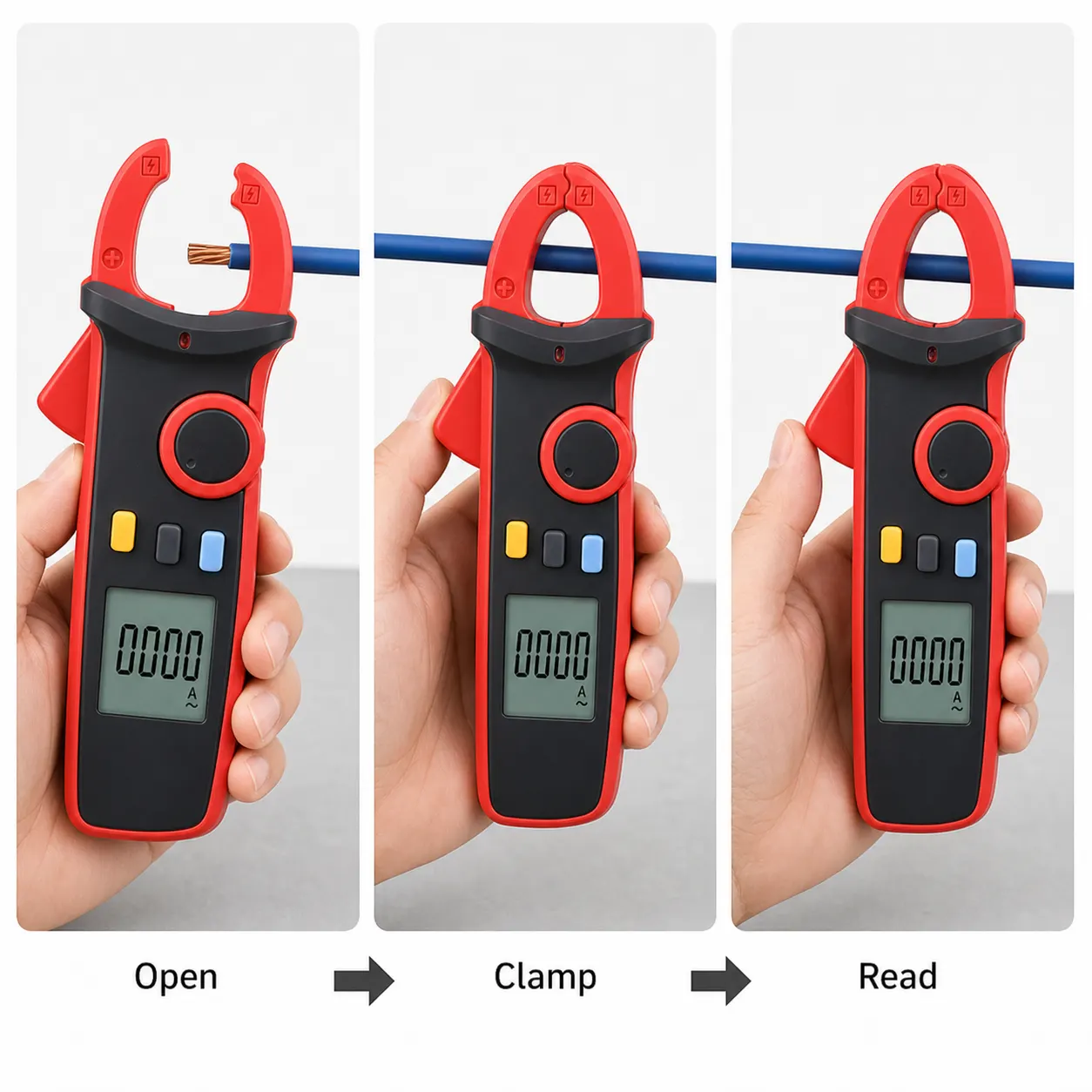
Place one conductor in the jaws
UNI-T directs the user to hook one wire, place it at the geometric centre indicated by the clamp head and make sure the left and right jaws are completely closed. These details are part of the measurement method, not optional tidying.
If the cable is too large, trapped in a bundle or inaccessible without disturbing protected parts, do not force the clamp into position. The manufacturer does not specify that every battery lead, earth strap or accessory loom will fit.
| Observation | Action | Reason |
|---|---|---|
| Display is not zero before clamping | Repeat the documented zeroing step | DC offset can affect the starting value |
| More than one conductor is inside the jaws | Reposition around the intended single conductor | The manual specifies one wire |
| Jaws do not close completely | Stop and choose suitable access or equipment | Full jaw closure is part of the instructions |
| Reading changes with vehicle activity | Record the state and repeat under controlled conditions | The meter alone does not explain the change |
Record conditions with the displayed value
Write down which conductor was clamped, the vehicle state, the selected function and whether the reading was stable. A number without those conditions is difficult to compare later. Repeating the same arrangement is more useful than moving the clamp around until a preferred value appears.
If the reading changes after a door, key, charger or accessory is used, document that event. Do not invent a pass threshold: the correct interpretation depends on the vehicle and its service information.
Know when this procedure stops
The manufacturer does not specify a vehicle-specific parasitic-draw threshold, fault diagnosis, logging capability, calibration certificate or high-voltage vehicle approval on the retailer page. The article therefore stops at a controlled current observation rather than a repair instruction.
HSE guidance says the meter should be suitably rated for the equipment under test and that clamp use requires adequate working space free from dangerous exposed conductors. If the circuit, access or expected current is uncertain, use the correct service procedure or a competent technician.
Related guides and product details
Use the UT210E sequence only for a documented, accessible circuit, then carry the recorded result into the vehicle-specific diagnostic process. Read Car Battery Drain Clamp Meter: A First-Check Method for related guidance. Read DC Clamp Meter for Car Battery Drain: UK Checklist for related guidance. Review the documented specification on the Compact DC clamp meter (UT210E configuration) product page before ordering.
Sources and safety context
- Supports the product configuration and compact clamp-style positioning. Current Amperemeter product page.
- Supports DC mode, zeroing, test-lead removal, single-wire placement and full jaw closure. UNI-T UT210E User Manual.
- Supports rating, inspection and working-space boundaries for electrical measurements. Electrical test equipment for use by electricians GS38.