
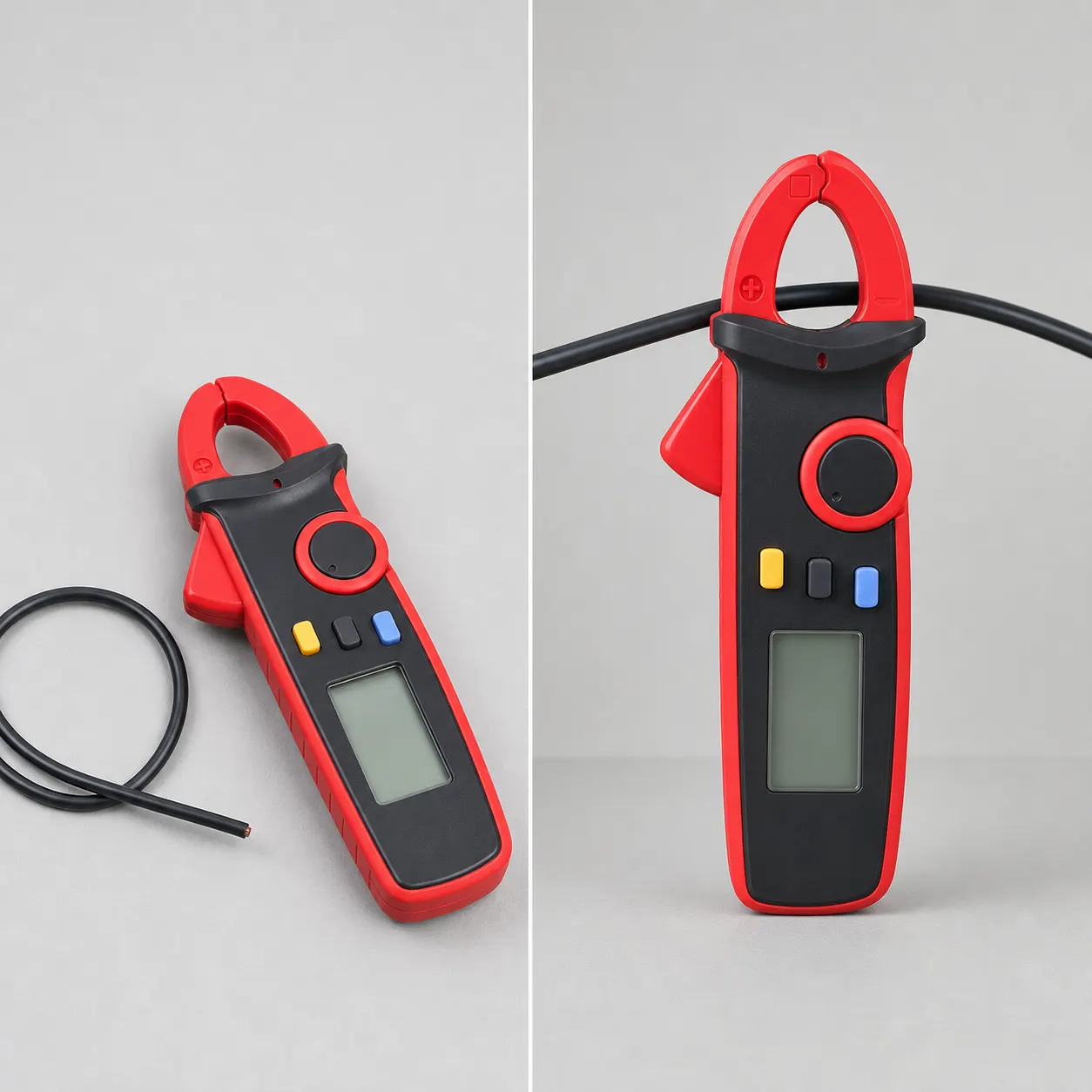
Short answer: For a first parasitic-draw observation, a DC clamp meter offers a different workflow from an inline multimeter: the clamp goes around one conductor, while an inline current measurement requires the meter to become part of the circuit. The listed UT210E configuration supports DC clamp-current measurement and a zeroing procedure, making it relevant when avoiding an initial disconnection is important. That convenience does not guarantee detection of every small or intermittent draw. The manufacturer does not specify a universal vehicle threshold, logging capability or vehicle approval on the product page. Choose between methods using the exact meter instructions, expected current, required resolution and vehicle service procedure.
Compare the two measurement workflows
The strongest reason to start with a clamp is procedural: the measured conductor can remain connected while the jaws are placed around it. This may preserve the vehicle state that the user wants to observe. The result still depends on zeroing, conductor placement and the meter's documented performance.
An inline multimeter requires a secure circuit connection and correct current input arrangement. HSE guidance says temporary current-measurement connections should be made with apparatus dead, secured before power is applied and adequately rated for the current and voltage involved.
| Decision point | DC clamp meter | Inline multimeter |
|---|---|---|
| Circuit connection | Clamps around one connected conductor | Meter becomes part of the current path |
| Key setup control | DC zero, central placement, fully closed jaws | Correct terminal, range, fuse and secure connection |
| Vehicle-state disturbance | No initial conductor opening for the clamp step | Connection procedure may alter the circuit state |
| Selection requirement | Suitable range, resolution and conductor access | Suitable current input, protection and connection method |
Choose by the evidence you need
If the immediate question is whether current can be observed without opening a battery-related conductor, a documented DC clamp method is relevant. If the required measurement is below the clamp meter's supported performance or the conductor cannot be enclosed, another approved method may be needed.
The manufacturer does not specify that the retailer's product will resolve every standby current or capture intermittent events. Check the current UT210E accuracy and range table rather than assuming that any visible digits are meaningful for the task.
Keep either method controlled
Whichever method is selected, write down the vehicle state, meter configuration, conductor or connection point and the event that changes the result. Change one condition at a time. A fault-finding record is useful only when another person can understand how the number was obtained.
- Define the expected current and evidence required from the test.
- Compare that need with the exact meter range, accuracy and instructions.
- Choose a connection method approved by the vehicle and instrument documentation.
- Create a stable vehicle state and record the initial result.
- Escalate through the service procedure rather than guessing from one number.
Limits before choosing the clamp
The manufacturer does not specify universal vehicle compatibility, a parasitic-draw pass value, logging, traceable calibration or approval for electric or hybrid high-voltage circuits on the product page. Those omissions matter more than the convenience of a compact body.
HSE GS38 requires electrical test equipment and accessories to be suitably rated and inspected, and it highlights secure, adequately rated connections for inline current measurement. Stop when the current, circuit or safe method is not known.
Related guides and product details
Choose the clamp workflow when its documented performance and conductor access fit the first observation; use an approved alternative when they do not. Read Automotive Current Clamp Meter: What to Check for related guidance. Read Automotive DC Current Clamp Meter: Setup Guide for related guidance. Review the documented specification on the Compact DC clamp meter (UT210E configuration) product page before ordering.
Sources and safety context
- Supports the UT210E configuration, compact clamp format and retailer claim limits. Current Amperemeter product page.
- Supports the manufacturer's DC clamp-current setup. UNI-T UT210E User Manual.
- Supports equipment selection and secure, adequately rated inline current connections. Electrical test equipment for use by electricians GS38.